-
Shop
- Advanced Technologies
- Beauty
- Best-Sellers
- Car Accessories
- Dating & Social Skills
- Digital Resources
- AI & Technology
- AI Skills
- Car Buying & Ownership
- Cozy Feast Collection
- Electronics & Technology
- Emotional Intelligence
- Financial Education
- Hobbies
- Home Styling & Organization
- Kitchen & Recipes
- Mindfulness
- Mindset
- Online Business
- Parenting & Child Development
- Pet Lifestyle & Wellness
- Positive Thinking
- Productivity
- Self Confidence
- Sleep Improvement
- Smart Life with AI
- Stress Management & Relaxation
- Travel Planning
- Yoga & Fitness
- Yoga & Mind-Body Practices
- Education & Learning
- Family & Parenting
- Fashion
- Fashion Accessories
- Furniture
- Gadgets
- Health & Beauty
- Health & Wellness
- Home & Garden
- Home Supplies
- Kids & Babies
- Kitchen
- Kitchen Best-Sellers
- Lighting
- Patio, Lawn & Garden
- Personal Growth
- Personal Style & Fashion
- Pet Care
- Pet Supplies
- Pets
- Sport & Outdoors
- Super Deals
- TikTok Growth & Monetization Mastery
- Travel
- Wealth
- Wealth Building
- Budgeting & Saving
- Cryptocurrency Investing
- Debt Management
- Entrepreneurship & Business Growth
- Family Finance & Budgeting
- Financial Independence
- Financial Mindset & Psychology
- Financial Planning
- Frugal Living & Expense Hacks
- Goal Setting
- High-Income Skills
- Investing Basics
- Leadership
- Motivation
- Networking & Mentorship
- Passive Income Strategies
- Real Estate Investing
- Side Hustles
- Stock Market Investing
- Wellness
- Popular
- Best deals
AI Social Media Captions: Hooks, Voice & CTAs That Convert

Magnetic Social Media Captions with AI: A Practical Playbook for Creators and Brands
Captions that stop the scroll usually follow a repeatable pattern: a clear hook, a specific promise, proof or context, and a simple next step. The fastest way to get consistent results with AI is to give it the right inputs—goal, audience, voice, offer, format, and constraints—so the output sounds human, fits the platform, and drives action without losing authenticity. For more guidance, see [PDF] AI TOOLS WITH DESCRIPTIONS – Tiffin University.
What Makes a Caption “Magnetic”
- Clarity first: one main idea per caption with a single, obvious takeaway.
- A strong first line: curiosity, contrast, specificity, or emotion that earns the next line read.
- Value density: a mini lesson, checklist, perspective shift, or relatable story beat.
- Voice consistency: a recognizable tone (playful, expert, bold, minimal, warm) across posts.
- A frictionless next step: comment, save, share, click, or reply—one action, not five.
The AI Input Recipe: 9 Details That Change Everything
AI gets “generic” when the input is generic. A few extra details can turn a bland caption into something that sounds like it came from a real person with a point of view. For further reading, see [PDF] Generative AI as Courtroom Evidence: A Practical Guide.
- Objective: awareness, engagement, leads, sales, community building, or retention.
- Audience snapshot: who it’s for, what they care about, what they’re skeptical about.
- Offer or topic: the specific idea, product, or story the caption supports.
- Proof or credibility: results, experience, data point, testimonial, or personal context.
- Voice rules: 3–6 descriptors plus do/don’t rules (example: “no hype, no slang, short sentences”).
- Format choice: story, list, myth-bust, mini-case study, hot take, Q&A, or tutorial.
- Platform constraints: character limits, hashtag approach, link placement, and whether emojis are allowed.
- Compliance/sensitivity: disclaimers, prohibited claims, safe wording (especially for health/finance).
- CTA style: low-friction (save/share), conversational (comment a word), or direct (DM for details).
Caption Building Blocks (Swap and Reuse)
| Block | Purpose | Examples (swap-in patterns) |
|---|---|---|
| Hook | Stops the scroll | “Most people get X wrong.” | “If you’re struggling with X, read this.” | “Unpopular opinion: X.” |
| Context | Explains why it matters | “Here’s what changed my results…” | “I used to think X until…” |
| Value | Delivers the payoff | 3 steps, 5 tips, a checklist, a short story with a lesson, a before/after |
| Proof | Builds trust | “After 30 days…” | “Client outcome…” | “A simple metric that improved…” |
| CTA | Directs next action | “Save this for later.” | “Comment ‘CAPTION’ for the template.” | “DM ‘INFO’ if you want help.” |
Reusable AI Instruction Templates for High-Performing Captions
Instead of asking for “a good caption,” request a specific structure. Then vary the angle so your posts don’t start sounding the same.
- Short-form hook: provide topic, audience pain point, desired emotion, and a 1-line takeaway; request 10 first lines in distinct styles.
- Story caption: provide a true moment, the lesson, and the transformation; request a 6–10 line story with a punchy final line.
- Educational list: provide a concept and 3–7 steps; request a scannable list with bold/short lead-ins and a save-focused CTA.
- Myth vs reality: provide common misconception, the truth, and one example; request a respectful correction without shaming.
- Launch/sales: provide offer, outcomes, who it’s for/not for, price/urgency rules; request 3 variants: soft, balanced, direct.
- Engagement driver: provide a polarizing-but-safe angle; request a question-based caption that invites experiences, not arguments.
Platform Tuning: Make the Same Idea Fit Instagram, TikTok, LinkedIn, and X
- Instagram: prioritize the first ~125 characters; use line breaks, micro-headings, and a save/share CTA. Hashtags can be minimal and intentional (see Instagram Help Center for official guidance).
- TikTok: write for a spoken voice; keep sentences short; add a natural question that matches your on-screen hook (reference: TikTok Business Help Center).
- LinkedIn: lead with a clear professional tension, add one concrete example, keep formatting clean, and end with a thoughtful question (see LinkedIn Marketing Solutions Blog).
- X: compress to one punchy point; use contrast; consider a micro-thread structure: hook → 2 bullets → takeaway.
- One input, many outputs: keep the same core claim and voice rules, but request versions tailored to each platform’s rhythm.
Brand Voice Guardrails: Consistency Without Sounding Robotic
A Simple Workflow to Produce 30 Captions in One Sitting
Common Mistakes That Make Captions Feel Generic
Recommended Downloads for Faster Caption Production
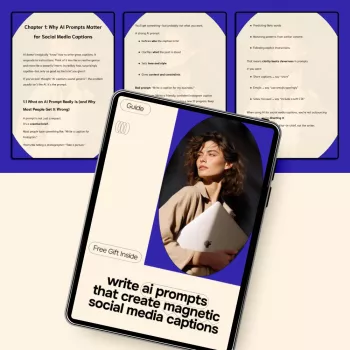
- Magnetic Social Media Captions Practical Guide (Digital Download) — a practical, reusable system for building strong hooks, voice rules, and platform-ready caption formats.
- The Ultimate Employee Motivation Checklist (Printable PDF Download) — helpful for leaders and B2B creators who need credible, people-first LinkedIn content that doesn’t feel salesy.
- Understanding Attachment Theory for Parents (Digital Download) — useful for parenting creators and family-focused brands looking to write sensitive, trust-building educational captions.
FAQ
How can AI-written captions still sound like a real person?
Use a simple voice card, provide a couple of brand-like examples, and require concrete details (numbers, moments, constraints). Then do a quick human edit focused on the first line and one clear takeaway.
What should be included in the input to get better captions?
Include your goal, audience snapshot, the topic or offer, proof, voice rules, format choice, platform constraints, compliance boundaries, and your preferred CTA style. The more specific the inputs, the less generic the output.
How many caption variations should be generated at once?
Generate 5–10 variations per idea, then keep 1–2 winners. Ask for different tones and different structures so you avoid “samey” phrasing across posts.















Leave a comment