-
Shop
- Advanced Technologies
- Beauty
- Best-Sellers
- Car Accessories
- Dating & Social Skills
- Digital Resources
- AI & Technology
- AI Skills
- Car Buying & Ownership
- Cozy Feast Collection
- Electronics & Technology
- Emotional Intelligence
- Financial Education
- Hobbies
- Home Styling & Organization
- Kitchen & Recipes
- Mindfulness
- Mindset
- Online Business
- Parenting & Child Development
- Pet Lifestyle & Wellness
- Positive Thinking
- Productivity
- Self Confidence
- Sleep Improvement
- Smart Life with AI
- Stress Management & Relaxation
- Travel Planning
- Yoga & Fitness
- Yoga & Mind-Body Practices
- Education & Learning
- Family & Parenting
- Fashion
- Fashion Accessories
- Furniture
- Gadgets
- Health & Beauty
- Health & Wellness
- Home & Garden
- Home Supplies
- Kids & Babies
- Kitchen
- Kitchen Best-Sellers
- Lighting
- Patio, Lawn & Garden
- Personal Growth
- Personal Style & Fashion
- Pet Care
- Pet Supplies
- Pets
- Sport & Outdoors
- Super Deals
- TikTok Growth & Monetization Mastery
- Travel
- Wealth
- Wealth Building
- Budgeting & Saving
- Cryptocurrency Investing
- Debt Management
- Entrepreneurship & Business Growth
- Family Finance & Budgeting
- Financial Independence
- Financial Mindset & Psychology
- Financial Planning
- Frugal Living & Expense Hacks
- Goal Setting
- High-Income Skills
- Investing Basics
- Leadership
- Motivation
- Networking & Mentorship
- Passive Income Strategies
- Real Estate Investing
- Side Hustles
- Stock Market Investing
- Wellness
- Popular
- Best deals
Rebuild Your Child Bond: Daily Steps That Restore Trust

Rebuilding Emotional Connection with Your Child: Practical Steps for Caring Parents
Emotional distance can show up quietly—short answers, more conflict, less sharing, or a sense that time together doesn’t “land” the way it used to. Reconnection is usually less about grand gestures and more about consistent, small experiences that restore safety, warmth, and trust. The goal is to create enough calm, predictable moments that a child feels seen and understood again—especially after stress, transitions, or repeated misunderstandings.
What Disconnection Can Look Like (and Why It Happens)
Disconnection doesn’t always look like dramatic defiance. Often it’s a series of small shifts that add up: increased irritability, withdrawal, avoidance of eye contact, “nothing” answers, sarcasm, more power struggles, or reluctance to ask for help.
These patterns commonly follow stressors such as school pressure, family conflict, parental burnout, major changes (a move, divorce, a new sibling), grief, or prolonged criticism and correction. Kids may protect themselves with distance when they expect misunderstanding, punishment, or dismissal—even when parents are deeply caring.
Reconnection becomes easier when the pattern is named gently. Instead of “You’re being difficult,” try: “Things have felt tense lately, and it matters to me that we get back on track.” That framing signals teamwork, not blame.
Start with Safety: The Three Foundations of Reconnection
1) Regulate first
A calm nervous system is contagious. Before problem-solving, lower intensity with slow breathing, a softer voice, and fewer words. If you feel yourself escalating, it’s okay to pause: “I need a minute to calm down so I can be kind.”
2) Repair predictably
When a moment goes poorly, circle back later with a short repair: acknowledge, validate, and reset expectations. Consistency matters more than perfection. Children rebuild trust when they see that conflict doesn’t threaten the relationship.
3) Prioritize connection over correction in high-impact windows
The first 10 minutes after school, bedtime, and right after conflict tend to carry extra emotional weight. Even small gestures—sitting nearby, a snack, a gentle question—can make those moments feel safer.
Two boosts that reduce power struggles
Warm attention helps kids return to closeness when they feel appreciated beyond behavior: noticing effort, interests, and small wins. And a “yes” environment (small choices within firm limits) reduces friction: “Do you want the blue cup or the green cup?” “Homework before or after snack?”
Daily Micro-Moments That Rebuild Trust
Trust usually returns through repetition. Aim for brief, low-pressure connection points that don’t depend on your child being cheerful or talkative.
- 10-minute child-led time: Let your child choose the activity; mirror their pace; avoid teaching, correcting, or multitasking.
- Two-sentence check-ins: “How was your day from 1–10?” and “What made it that number?” keeps it light but meaningful.
- Name the feeling before the fix: “That was disappointing,” “You’re frustrated,” “You really wanted that to work.” Validation lowers defensiveness.
- One positive touchpoint per transition: Greeting, pickup, bedtime, or leaving the house. Predictable warmth at transitions reduces distance.
- Catch the moment you almost react: Pause, describe what you see, and ask one curious question. Curiosity reopens closeness.
7-Day Connection Reset (10–15 minutes a day)
| Day | Action | What to Notice |
|---|---|---|
| 1 | Child-led play or activity (no teaching/correcting) | Any smiles, longer eye contact, relaxed body |
| 2 | Two-sentence check-in at a calm time | More detail than usual; fewer “fine” answers |
| 3 | “I notice…” appreciation (effort or kindness) | Reduced pushback; subtle pride |
| 4 | Repair a past moment: brief apology + new plan | Lower tension; willingness to re-engage |
| 5 | Do one small task together (cook, tidy, walk) | Cooperation; shared rhythm |
| 6 | Offer a choice that preserves limits | Less arguing; quicker compliance |
| 7 | Bedtime connection: recap one good moment + one hope | More calm at bedtime; improved closeness |
Repair Conversations After Conflict: A Simple Script
Repairs work best when everyone is calm, not mid-argument. Keep it short and steady—long explanations can feel like lectures. The aim is safety and reconnection, not winning the story.
- Step 1: Own your piece. “Earlier I raised my voice.”
- Step 2: Validate their experience. “That probably felt scary or unfair.”
- Step 3: Agree on the next step. “Next time I’ll take a pause first. Can we try again?”
Invite their perspective with one question—without cross-examining: “What was that like for you?” When a child feels heard, cooperation often follows later.
When Your Child Pushes You Away: What Helps (and What Backfires)
Some kids reconnect through talking; others reconnect through proximity and routine. If your child shuts down, aim for availability without pressure.
Using a Structured Guide to Stay Consistent
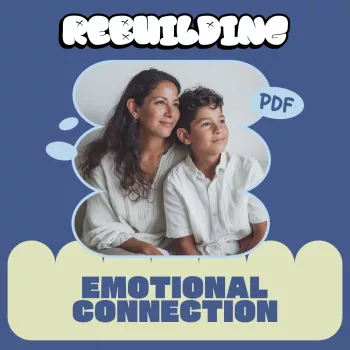
- Rebuilding Emotional Connection with Your Child (practical eBook guide)
- Understanding Attachment Theory for Parents (digital download)
Related Reading: Attachment and Emotional Bonding
For deeper, research-informed background, explore Harvard’s “Serve and Return” and the American Psychological Association’s guidance on building resilience.
FAQ
How long does it take to rebuild emotional connection with a child?
Small shifts can appear in days (less tension at transitions), while noticeable trust often takes a few weeks of steady routines and predictable repairs. After major stress or repeated conflict, it can take longer; measure progress by quicker recovery after disagreements and more willingness to share.
What if my child refuses to talk or spend time together?
Keep connection low-pressure: parallel activities (walking, cooking, riding in the car), brief check-ins, and short child-led time without teaching or interrogating. Stay available with warmth—“I’m here when you’re ready”—and let consistency do the heavy lifting.
When should a parent consider professional help?
Consider support if withdrawal is persistent, there’s talk of self-harm, severe anxiety, escalating aggression, trauma history, school refusal, or family conflict that isn’t improving. A pediatrician, school counselor, or licensed family therapist can help you assess what’s driving the pattern and build a plan.















Leave a comment