-
Shop
- Advanced Technologies
- Beauty
- Best-Sellers
- Car Accessories
- Dating & Social Skills
- Digital Resources
- AI & Technology
- AI Skills
- Car Buying & Ownership
- Cozy Feast Collection
- Electronics & Technology
- Emotional Intelligence
- Financial Education
- Hobbies
- Home Styling & Organization
- Kitchen & Recipes
- Mindfulness
- Mindset
- Online Business
- Parenting & Child Development
- Pet Lifestyle & Wellness
- Positive Thinking
- Productivity
- Self Confidence
- Sleep Improvement
- Smart Life with AI
- Stress Management & Relaxation
- Travel Planning
- Yoga & Fitness
- Yoga & Mind-Body Practices
- Education & Learning
- Family & Parenting
- Fashion
- Fashion Accessories
- Furniture
- Gadgets
- Health & Beauty
- Health & Wellness
- Home & Garden
- Home Supplies
- Kids & Babies
- Kitchen
- Kitchen Best-Sellers
- Lighting
- Patio, Lawn & Garden
- Personal Growth
- Personal Style & Fashion
- Pet Care
- Pet Supplies
- Pets
- Sport & Outdoors
- Super Deals
- TikTok Growth & Monetization Mastery
- Travel
- Wealth
- Wealth Building
- Budgeting & Saving
- Cryptocurrency Investing
- Debt Management
- Entrepreneurship & Business Growth
- Family Finance & Budgeting
- Financial Independence
- Financial Mindset & Psychology
- Financial Planning
- Frugal Living & Expense Hacks
- Goal Setting
- High-Income Skills
- Investing Basics
- Leadership
- Motivation
- Networking & Mentorship
- Passive Income Strategies
- Real Estate Investing
- Side Hustles
- Stock Market Investing
- Wellness
- Popular
- Best deals
Trust-Building Content Toolkit: Framework, Templates, Prompts

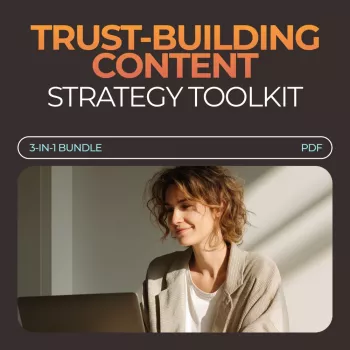
Trust-Building Content Strategy Toolkit: 3-in-1 Bundle for Content That Builds Trust Fast
Trust is earned in small, consistent moments—clear messaging, proof that claims are real, and a customer experience that feels transparent. The Trust-Building Content Strategy Toolkit: 3-in-1 Bundle for Content That Builds Trust Fast is designed to remove guesswork from content planning by turning trust principles into repeatable assets: a strategy framework, ready-to-use templates, and practical prompts that help teams publish confidently and consistently.
When customers can quickly understand what you do, how it works, and what results are realistic, they’re more likely to take the next step—without needing extra pressure, gimmicks, or constant back-and-forth. This toolkit supports that kind of clarity-first credibility.
What “trust-building content” looks like in practice
- Specific over vague: concrete outcomes, timelines, and boundaries replace broad promises.
- Evidence over hype: testimonials, case studies, data points, screenshots, and process transparency lead the message.
- Consistency over intensity: a reliable cadence reinforces credibility more than occasional bursts.
- Customer-first clarity: plain language, clear pricing logic, and frictionless next steps reduce uncertainty.
- Tone alignment: confident, calm, and precise—no exaggeration or fear-based urgency.
These principles align with established UX guidance on credibility and user trust (see Nielsen Norman Group’s research on trust and credibility) and with compliance expectations around substantiating claims (see FTC advertising and marketing guidance).
What’s inside the 3-in-1 bundle
- Strategy framework that maps audience concerns to content that resolves doubts quickly.
- Template set for repeatable trust assets (about pages, FAQs, product/service pages, onboarding emails, and proof-driven posts).
- Prompt and checklist system that speeds up drafting while protecting brand consistency.
- A plug-and-play workflow that supports solo creators and small teams without adding tools.
Bundle components and the trust outcome they support
| Component | Best used for | Trust signal reinforced | Example deliverables |
|---|---|---|---|
| Core strategy framework | Planning and prioritization | Competence and clarity | Content pillars, message hierarchy, audience doubts map |
| Copy + page templates | Fast production | Transparency and consistency | Sales page blocks, FAQ modules, “how it works” sections |
| Prompts + checklists | Quality control | Reliability and integrity | Tone guardrails, proof checklist, claims-to-evidence mapping |
Who benefits most (and when it’s the right fit)
- Newer brands that need credibility fast without over-discounting or over-promising.
- Established businesses refreshing messaging after a product update, reposition, or audience shift.
- Service providers whose value is hard to “see” without structured proof and process content.
- Teams that publish inconsistently and need a simple system to maintain momentum.
- Creators selling digital products who want fewer refunds driven by unclear expectations.
If a buyer has to decode what’s included, guess whether results are typical, or chase down basic details, skepticism is a natural outcome. Trust-building content closes those gaps upfront—so the sales conversation starts from clarity, not confusion.
A simple 7-day rollout plan
- Day 1: Define the trust goal (reduce objections, increase consult bookings, improve trial-to-paid conversion).
- Day 2: List top customer doubts and match each to proof (data, screenshots, testimonials, process steps).
- Day 3: Draft a clearer “how it works” and outcomes-with-boundaries section.
- Day 4: Publish one proof asset (case study, results post, behind-the-scenes process breakdown).
- Day 5: Update product/service page with stronger claims-to-evidence alignment.
- Day 6: Add an FAQ that addresses the most common hesitation points directly.
- Day 7: Build a repeatable weekly cadence (1 proof piece, 1 teaching piece, 1 clarity piece).
This pace works because it prioritizes buyer confidence: first, define what “trust” needs to do for your offer; then, publish proof and clarity where it matters most.
Content types that build trust fastest
- “How it works” explainers that reduce uncertainty and set expectations before purchase.
- Before/after case studies with context (starting point, constraints, timeline, method) so results feel believable.
- Decision guides that help customers self-qualify (who it’s for / not for).
- Transparent pricing logic and scope boundaries that prevent surprises.
- Objection-handling FAQs that answer concerns without defensiveness.
How to measure whether trust is increasing
- Qualitative signals: better-fit leads, fewer repetitive pre-sale questions, more confident buyer language.
- Behavioral signals: longer time on key pages, more scroll depth, higher return visits.
- Conversion signals: improved opt-in rates, consult booking rate, and checkout completion.
- Support signals: fewer refunds tied to expectations, fewer “didn’t realize” complaints.
- Content signals: increased saves/shares on proof-led and clarity-led posts.
Common mistakes that quietly reduce credibility
Getting started with the toolkit
For teams pairing clearer external messaging with stronger internal follow-through, the The Ultimate Employee Motivation Checklist: Spark Your Team’s Drive in 7 Easy Steps! can support a healthier execution rhythm—especially when consistent publishing depends on consistent ownership.
Recommended in-stock resources
- Trust-Building Content Strategy Toolkit: 3-in-1 Bundle for Content That Builds Trust Fast
- The Ultimate Employee Motivation Checklist: Spark Your Team’s Drive in 7 Easy Steps!
FAQ
How quickly can content start building trust?
Clarity improvements can help within days, especially on core pages like “how it works,” pricing, and FAQs. Stronger results typically show up over a few weeks as proof assets accumulate and your claims stay consistent across channels.
What if there are no case studies yet?
Start with alternative proof: show your process step-by-step, share small wins and early results from pilots, highlight relevant credentials, and use reviews or community feedback with context. The goal is to make your competence visible, even before you have long-form case studies.
Does this work for both products and services?
Yes—products usually benefit most from demonstrations, comparisons, and tight FAQs, while services benefit from process transparency, scope boundaries, and outcome examples with clear context. The underlying structure stays the same: align each meaningful claim with evidence that reduces doubt.















Leave a comment